Regular home cleaning, deep cleans, short-let turnovers and after-builders work — in English or Português.
This is the heaviest job in the trade and the most underestimated, including by the people who order it. The reasons are physical, and they are why we quote it separately from any other kind of clean.
This is the order we work in, and it is the order any competent job follows. If a quote you have describes something different, ask why — there is usually a good reason or a bad one.
Loose debris out first, with a filtered vacuum rather than a brush, working from ceiling level downwards. Sweeping puts everything you just captured back into the air.
Grout haze, paint speckle, adhesive, silicone and label glue, each with the product it needs and tested somewhere invisible first.
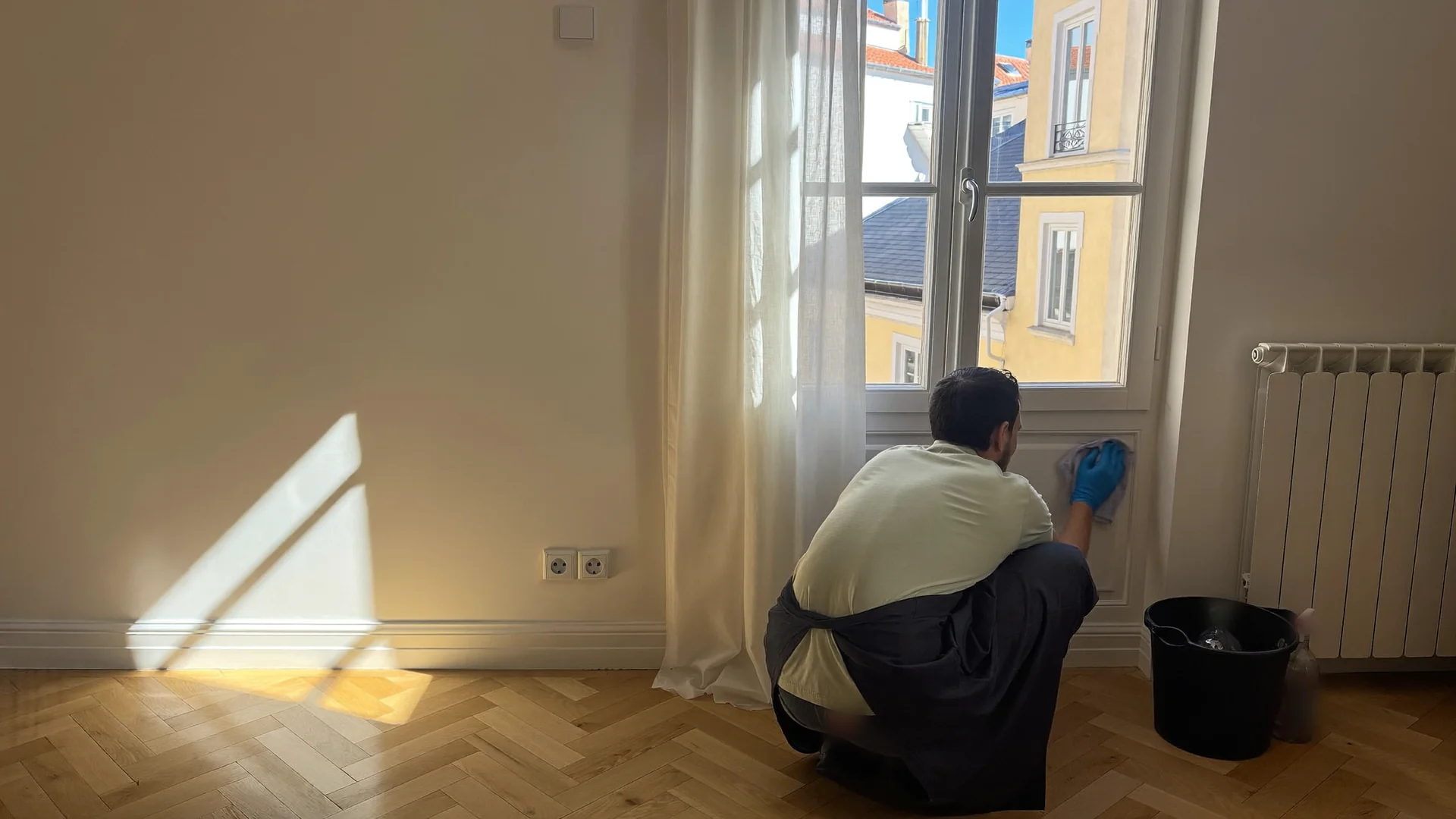
Frames, sills, hinges, sockets, radiators, grilles, the tops of doors, and the inside of new cupboards where sawdust always survives.
Windows and glazed doors on both sides, then the floors last of all, with the method the floor actually tolerates rather than the fastest one.
On price: four Portuguese sources put a full post-renovation clean at €240–400 for a job. Portuguese searches for this work include an explicit price-per-square-metre variant, which tells you how it is usually quoted here: by area, with the state of the site adjusting it up or down. Indication from public price pages, not a quote. The hourly figures come from spicandspan.pt, idealista.pt and zaask.pt; the monthly figure from viplimpezas.pt; the after-renovation figure from Zaask, Habitissimo, lipclean and fixhomeservicios. All read in August 2026. We quote your job on what we can see in your photos, not on a table. More context on the prices page, and the Portuguese version of this page is at limpeza pós-obra em Lisboa.
A builder's sweep removes what you can see: rubble, offcuts, the worst of the dust. A handover clean removes what you cannot, from the top of the door frames to the inside of the new drawers, and deals with residues that a broom cannot touch. Many contracts include the first and quietly assume somebody else pays for the second.
After the last tradesperson has finished and before the floors get their final protection removed or the furniture arrives. Booking it while one small job is still outstanding is the classic mistake: whoever comes back to finish the skirting will undo a morning of work in ten minutes. Tell us the builders' end date and we work back from it.
We say exactly which of them are in your price before you agree it, because it varies more here than in any other part of the job. External glass above ground floor, roller shutter boxes and balcony tiling are frequently priced separately, and in a building with no safe access some of it needs equipment nobody brings by default.
That is exactly what separates this from a normal deep clean, and it is where the risk of damage sits. Each residue needs its own product, and on natural stone, microcement or a treated wood floor the wrong one leaves a permanent mark. Tell us what the surfaces are when you ask, and we will tell you what we can and cannot safely do to them.
In most arrangements, the builder — and it belongs in their contract, not in our price. Portuguese municipalities also have rules about construction waste that do not allow it in the ordinary street containers. We flag it before the day so it does not become an argument on it.
Because floor area is the only number both sides can agree on before anyone has seen the site. It is a starting point rather than an answer: two flats of the same size can differ by a full day depending on how much glass there is, how bad the residues are, and whether there is a lift. That is why we ask for photos.
The state of the floors, how much glass there is, and the date it has to be ready. Those three things tell us the price faster than the square metres do.
Tell us the size, the surfaces and the date. We say straight away whether we can be there in time.