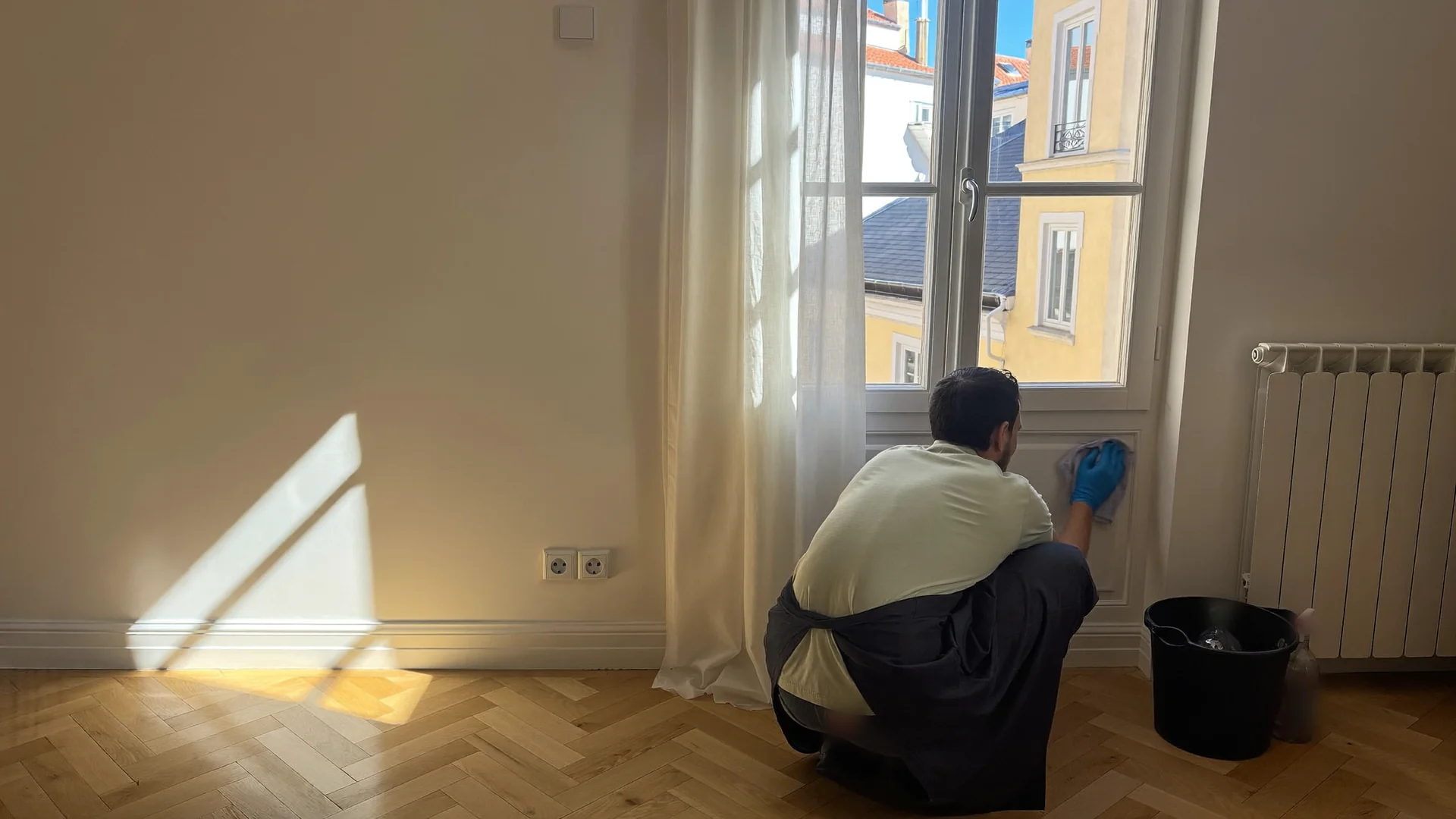
Regular home cleaning, deep cleans, short-let turnovers and after-builders work — in English or Português.
Every figure below comes from a Portuguese price page or marketplace that publishes it openly. None of them is your price — yours comes from us, on your actual property — but they tell you whether any number you are shown is inside the market or outside it.
Indication from public price pages, not a quote. The hourly figures come from spicandspan.pt, idealista.pt and zaask.pt; the monthly figure from viplimpezas.pt; the after-renovation figure from Zaask, Habitissimo, lipclean and fixhomeservicios. All read in August 2026.
Read the two hourly figures together. The same hour of the same work is advertised at €8–15 in the Portuguese-language market and at €16.90 in the English-language segment. That gap is not a mistake and it is not a quality difference — it is a language and a channel difference. Knowing it exists is the most useful thing on this page, because it tells you the range you are actually negotiating inside. We quote in either language and it is the same number.
Two flats of identical size routinely get quotes that differ by half. These are the reasons, roughly in order of how much they matter, and they are what we ask you about before we put a figure on anything.
The figures on this page are a sanity check, not a target. Here is how to put them to work — on us as much as on anybody else you ask.
Ask the same three questions every time: how many hours, what is included, and does the price carry IVA. Two quotes that differ by a third usually differ by an hour and an oven, not by greed. Ours answers all three before you ask.
'Deep clean' means nothing consistent. 'Five hours with two people, including the oven and the inside of the fridge' means something you can hold somebody to and compare against the next quote. That is how we write ours.
The lowest published hourly figure in this market is what an individual charges informally, without an invoice. It is a real price for a real arrangement — just be clear which one you are buying, and ask what happens if something gets broken before you decide.
Because they are two different sales channels. Businesses advertising in English reach an audience that finds them through search, expects written communication and pays by transfer, and they price for that. The measured gap in this market is roughly €8–15 an hour against €16.90. Write to us in either language: it makes no difference to the figure we send back.
Not proportionally. A large open apartment with three surfaces can be quicker than a small one with two bathrooms, a galley kitchen and a balcony, because time is spent on edges, corners and fittings rather than on open floor. This is why quoting by square metre is a starting point and not an answer.
Hourly suits a regular slot where the work is predictable. Fixed suits one-off jobs with a defined outcome — a handover, a post-renovation clean — where you care about the result and not about the clock. We tell you which one we are quoting, and we do not mix them by agreeing a fixed price and then adding tasks.
IVA is quoted differently by different businesses, so always ask; ours is stated. Products are sometimes yours to supply. Travel is normally absorbed but not always, especially outside the city. And every figure here describes labour — nothing on this page includes equipment hire, waste removal or repairs.
You may be offered it, and it should be your choice rather than a condition. The cleaner who does the work issues the invoice with IVA. If you want it in a specific name or with your taxpayer number on it — worth having, particularly for a rental property — tell us before the work rather than after.
Usually yes, and it is the one negotiation almost everybody skips. Certainty is worth a lot when you are planning routes. Offering the same day and time every week for six months buys you more than arguing over a euro an hour does, and it is the version of this conversation we will actually engage with.
Your price depends on the floor, the lift, the surfaces and how often. Send us those four things and you get an actual figure back, for your actual property, today.
Free, no obligation, and no pressure to accept the figure we send back.